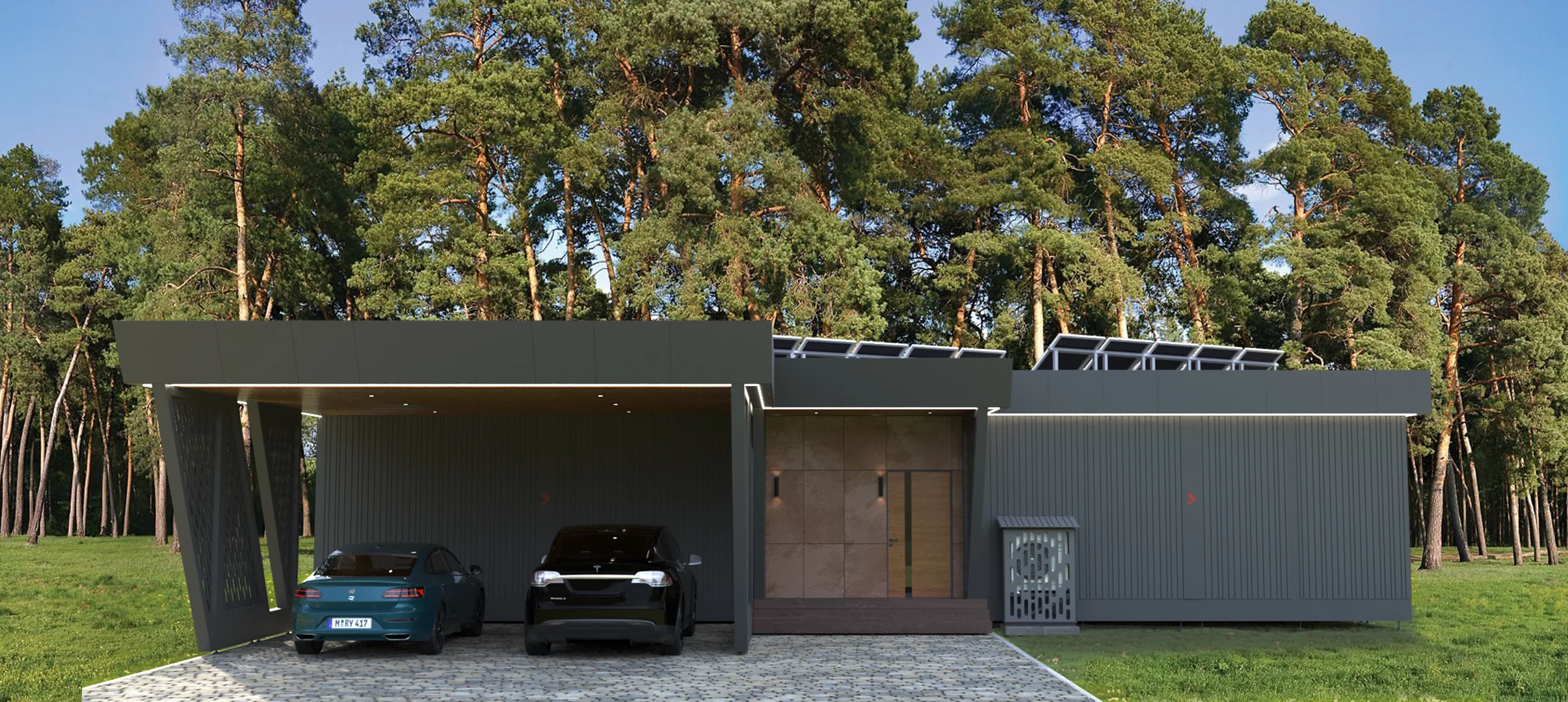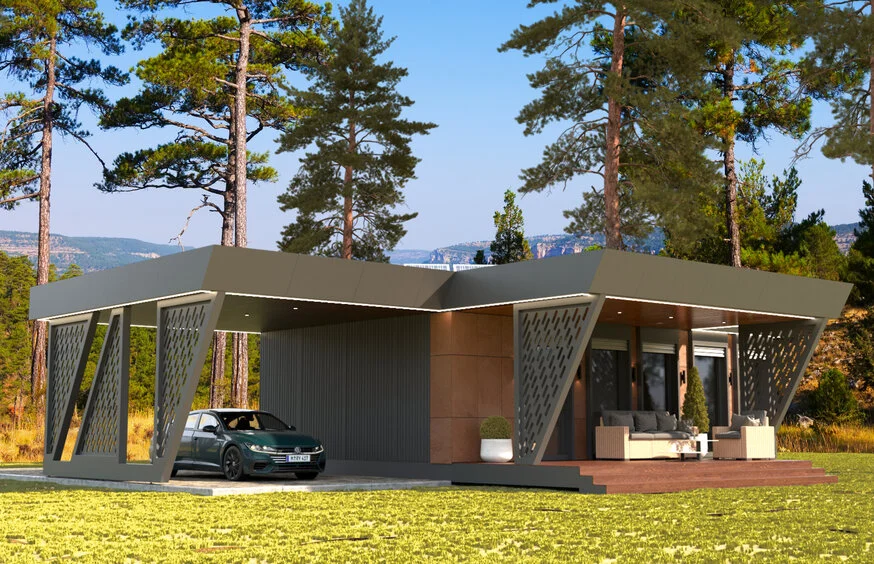
This guide is about registering your place of residence in Ukraine when you live in a prefab house. The house may already stand on its plot and be ready to live in, but you can only file a residence declaration (deklaruvannia mistsia prozhyvannia) once the state registers recognise it as a residential house with an address and a registered owner. Ukrainians still call this propyska, the old word for a residence stamp, while the law speaks of declaring or registering a place of residence. Below is the procedure as of October 2026, from the land plot and building permits to the application in Diia (Ukraine’s state e-services app) or at an ASC/TsNAP (administrative service centre).
What the law requires of a home
Residence declaration and registration are governed by Law No. 1871-IX, and the procedure is set out in more detail in Cabinet of Ministers Resolution No. 265 of 7 February 2022. For a prefab house, these documents boil down to three conditions:
- The house is a dwelling. The law defines a dwelling as “a residential house, an apartment or other living premises”. If the address belongs to a property that is not a dwelling, registration will be refused (Art. 12).
- The house has an address. The same article gives another ground for refusal: the dwelling “has not been assigned an address in the established manner”.
- Ownership is entered in the State Register of Real Property Rights (Derzhavnyi reiestr rechovykh prav na nerukhome maino). You can declare your residence online “only in a dwelling whose details are entered in the State Register of Real Property Rights” (Art. 8).
Garden houses and dachas (country cottages) have a separate rule. A residence declaration is possible there only “after such a house has been converted into a residential house” (Art. 5(10)).
A house on screw piles: real estate or not?
Article 181 of the Civil Code of Ukraine classes as real estate any object on a land plot that “cannot be moved without losing its value and changing its purpose”. Under the Law “On Regulation of Urban Planning Activities” (Art. 28), a temporary structure is a single-storey building made of lightweight elements, put up for a limited time “without a foundation”. Rights to temporary, non-permanent structures are not entered in the register (Art. 5 of Law No. 1952-IV).
Courts look at what the object actually is, beyond the entry in the register. In 2024, in case No. 914/1785/22, the Grand Chamber of the Supreme Court of Ukraine found the disputed premises to be temporary structures and ruled that registering them as real estate had been a mistake.
In practice, a prefab house becomes a residential house once it goes through the chain “construction passport, notice of commencement of works, declaration of readiness, registration of ownership”. Until those documents exist, the registers see no dwelling at that address, and you cannot declare your residence there. If you might move the house one day, talk to a lawyer about the consequences before installation: real-estate status ties the building to a specific plot.
Step 1. The land plot and permits
- Check the plot’s designated purpose. The simplest case is code 02.01, “for the construction and maintenance of a residential house, outbuildings and structures (household plot)”, in the classification of land-use purposes. On a plot coded 01.05, “for individual gardening”, you build a garden house, and you will have to convert it into a residential one before declaring your residence there.
- Make sure your right to the land is registered. Without a document for the plot you will not get a construction passport. If the right is not in the register, attach the document proving ownership or use to the application.
- Get a construction passport (budivelnyi pasport). It covers a detached, garden or country house of no more than two storeys (not counting an attic floor) and up to 500 m². You apply through Diia or an ASC/TsNAP and attach a sketch of the planned development showing where the house will stand, the distances to the plot boundaries and utility lines, the facades and the floor plans. The service is free and takes 10 days.
- File a notice of commencement of construction works (povidomlennia pro pochatok budivelnykh robit). For buildings under a construction passport and buildings in consequence class CC1, the right to build arises from this notice (Art. 36 of the urban planning law). File it before the screw piles go into the ground, because carrying on works without the notice is prohibited.
- Apply for an address. The law lets the client choose when: after getting the right to build or after the house is accepted into operation. The address-assignment authority has five working days to respond (Art. 26-4). The procedure is described in Cabinet of Ministers Resolution No. 690. The address counts as assigned from the day it is entered in the Construction Activity Register in YeDESSB (Ukraine’s Unified State Electronic System in Construction).
Step 2. After installation: acceptance into operation and ownership
- Order a technical inventory survey (tekhnichna inventaryzatsiia). A surveyor measures the house and draws up a technical passport with its main characteristics and technical and economic indicators. You cannot file the declaration without it.
- Register the declaration of readiness for operation (deklaratsiia pro hotovnist obiekta do ekspluatatsii). You apply through Diia or an ASC/TsNAP. Registration is free and takes up to 10 working days (Art. 39). If the address was assigned during construction, no separate decision on it is needed now: once the declaration is registered, the system notifies the address-assignment authority itself (Art. 26-3). If you postponed the address, apply for it right after acceptance into operation.
- Register ownership. Go to an ASC/TsNAP, a state registrar or a notary. It takes up to five working days, and the administrative fee in 2026 is UAH 330. The registrar takes the details of acceptance into operation and the address from YeDESSB.
- Sign utility contracts. A registered declaration is the basis for supply contracts for a building accepted into operation (Art. 39(9)). Budget for site preparation and utility connections separately from the price of the house.
Step 3. Declaring in Diia or registering at an ASC/TsNAP
- Online through Diia. The service is open from age 14. You need an RNOKPP (Ukrainian taxpayer registration number) and Diia.Signature or a qualified electronic signature (KEP), and your ownership must be in the property register. The home cannot be mortgaged or held in trust. If you declare in a house you own, the application is processed automatically in 10 to 15 minutes. Note that the service currently works only for people who are not liable for military service (viiskovozoboviazani).
- On paper at an ASC/TsNAP. This route is for anyone who cannot use the online option. Along with the application you bring your passport, a document confirming your right to the home and a receipt for the fee; people liable for military service also bring their military registration document (Art. 9). The details go into the register on the day you apply, or on the next working day if the ASC/TsNAP accepted the documents (Art. 10).
- Keep to the deadline. You must declare or register your residence within 30 calendar days of arriving (Art. 5). The fee in Diia is UAH 49.92 if you are declaring for the first time or deregistered from your previous address less than 30 days ago, and UAH 83.20 if more time has passed. It is not refunded if the application is rejected.
Documents and timelines
| Document or step | Where to get it | Approximate time and cost |
|---|---|---|
| Construction passport | Diia or ASC/TsNAP | 10 days, free |
| Notice of commencement of works | Diia or ASC/TsNAP | Automatic or 5 days (+5 days to verify the details), free |
| Address assignment | Address-assignment authority of the local council | 5 working days |
| Technical passport | Technical inventory contractor | As agreed with the contractor |
| Declaration of readiness for operation | Diia or ASC/TsNAP | Up to 10 working days, free |
| Registration of ownership | ASC/TsNAP, state registrar, notary | Up to 5 working days, UAH 330 (2026) |
| Online residence declaration | Diia | 10 to 15 min for the owner, UAH 49.92 or UAH 83.20 |
| Residence registration on paper | ASC/TsNAP, registration authority | Same day or next working day |
| Converting a garden house into a residential one (if needed) | Executive body of the local council | Decision within a month |
Frequently asked questions
Can I register my residence in a garden house?
Only after it has been converted into a residential house. Article 5(10) of Law No. 1871-IX says so directly. The conversion procedure is set by Cabinet of Ministers Resolution No. 321: the owner submits to the local council an application, a copy of the ownership document and a technical inspection report on the house. The council decides within a month.
Can I declare my residence before the house is registered as real estate?
No. Without an address and a residential house in the register, the registration authority will refuse under Art. 12 of Law No. 1871-IX. You first need the declaration of readiness and the registration of ownership.
I am liable for military service. What should I do?
The online service in Diia is currently not available to you. Go to an ASC/TsNAP with your passport, the documents for the house, the fee receipt and your military registration document.
When can I connect electricity, water and gas?
The law names a registered declaration of readiness for operation as the basis for supply contracts. Plan the utilities and the paperwork in parallel so you are not left waiting after installation.
Is a residence declaration mandatory?
The law requires it within 30 calendar days of arriving at a new address. If you miss the deadline, the fee in Diia is higher: UAH 83.20 instead of UAH 49.92.
Before you choose a house
Getting to a residence declaration starts with the land plot. Its designated purpose and a registered right to the land decide whether a construction passport is enough. Models with floor areas and package options are in the HOMERS catalogue, and scenarios for a private home are on the Homes for living page. If you do not have a plot yet, HOMERS offers help finding one: get in touch through the contact page.
This article is not legal advice. Rules change, so check the current versions of the laws or consult a lawyer before you file any documents. The information is current as of October 2026.