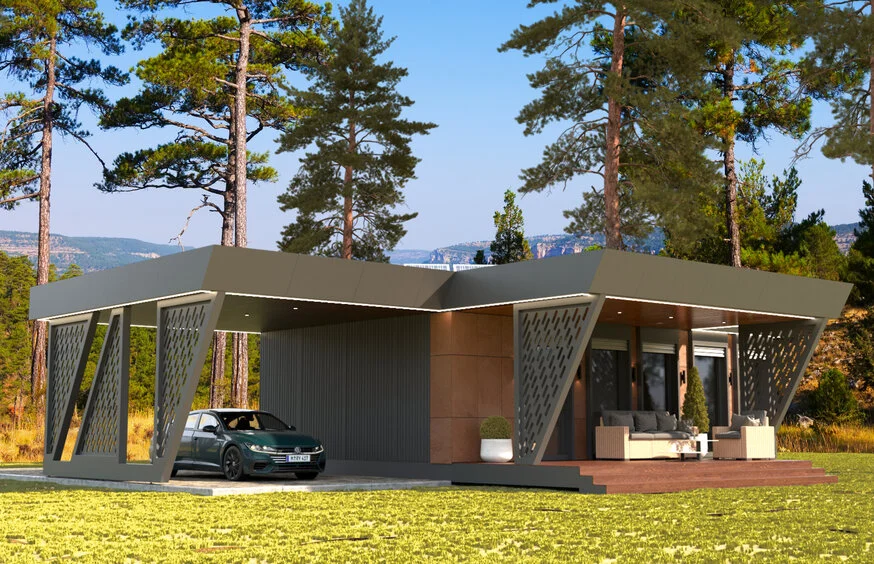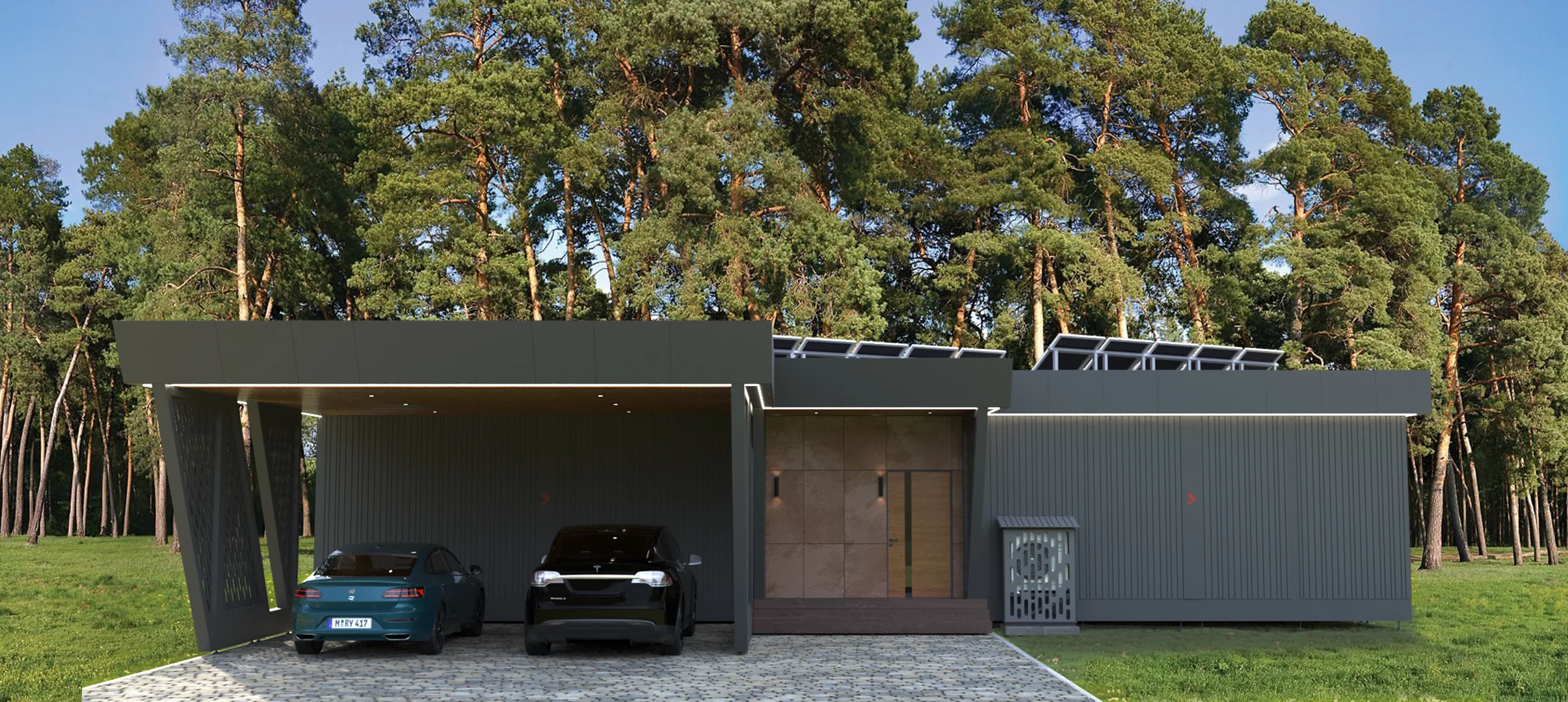
A prefab house is assembled on site from parts that have already been made in a factory. Most of the work happens on the factory floor, and what’s left for the site is the foundation, assembly and utility connections. Below we look at the main types of prefab homes, the route from contract to keys, and what the budget actually includes.
What prefab means in plain terms
Prefab is short for prefabricated, meaning made in advance. The McKinsey report “Modular construction: From projects to products” (2019) describes this kind of construction as producing standardised building components in a factory and then assembling them on site. The report uses prefab, offsite and modular construction as synonyms.
The main difference from brick or aerated concrete block is where the work gets done. Masonry goes up in the open air, at a pace set by the crew and the weather. Factory components are made indoors while the foundation is being prepared on site. A review by the US Department of Energy (2024) says this parallel work, together with less exposure to weather, shortens schedules on modular projects by 20 to 50%. McKinsey gives the same range. These are industry averages, not a promise for any particular house.
Types of prefab houses
There is no single classification. A handy reference point is the UK MMC framework, drawn up in 2019 by a working group set up by the UK government. It sorts modern methods of construction into seven categories, and three of them matter in practice for a private house.
Volumetric modules (3D)
The factory builds complete room units with finishes and services already in place, and on site a crane sets them side by side or stacks them. This moves the most work into the factory, but size becomes the limiting factor. According to McKinsey, a road that can be used without a police escort is usually about 3.5 m wide, which directly caps how wide a module can be. In their calculation, delivery over roughly 250 km cost almost $45 per square metre for volumetric modules, compared with about $8 for panels.
Panel systems (2D)
The factory makes walls, floors and the roof as panels, often with service channels already built in, and the house is put together from them on site. Panels are cheaper to transport, and the floor plan depends less on the size of a truck bed. That is why, as McKinsey notes, this approach suits high-end private homes and open-plan layouts better.
Individual factory-made components
The house itself can be conventionally built, with only some parts coming from a factory: stairs, bathroom pods, roof trusses.
HOMERS uses the panel approach. The structural panels are made of galvanised steel on robotic CNC lines with a precision of ±0.5 mm. The technology page explains how the wall is built and what it is insulated with.
From contract to keys: how the process works
Here is how it works at HOMERS.
- Model and specification. The catalogue has seven models with total areas from 121.2 to 363.2 m², and three specification levels: Basic, Comfort and Full House.
- Plot. Surveying and site preparation are handled separately from the house. This is also the time to check that a truck carrying the panels can reach the plot.
- Manufacturing. About 30 days at the factory in Vyshneve near Kyiv or in Velky Saris, Slovakia, covering CNC fabrication and quality control. The manufacturing page shows how it is organised.
- Foundation. Screw piles (ground screws) go in within one to two days, with no concrete work.
- Assembly. 7 to 14 days: the panels first, then the building services.
- Utility connections and handover of the keys.
The exact schedule for your plot is set out in the contract. Building permits run on a separate track. In Ukraine they go through the Unified State Electronic System in Construction, and some of the services are available in Diia (Ukraine’s state e-services app). Wherever your plot is, find out what paperwork it will need before you buy it.
What makes up the budget
The catalogue price and the cost of a house you can move into are two different numbers. HOMERS lists its prices as “from”, for the Basic specification, excluding assembly, foundation and delivery. Basilio, for example, starts at $91,500 in Basic and at $133,500 in Comfort.
| Item | What it covers | In the catalogue price |
|---|---|---|
| House, Basic | Structure, facade, windows, doors, terrace, smart home; interior to the client’s brief | Yes |
| Comfort | Basic plus interior finishing, kitchen, bathroom, heating | Priced separately (Basilio from $133,500) |
| Full House | Comfort plus furniture, appliances, furnished terrace | On request |
| Delivery | Transporting the panels from the factory | No |
| Foundation | Ground screws | No |
| Assembly | Putting the house together on site | No |
| Plot | Surveying, site preparation | No |
| Utilities | Connection to the mains | No |
When you compare with brick or timber frame, compare the same scope of work: shell with shell, turnkey with turnkey. Otherwise the comparison is unfair, and it can be skewed in either direction.
If the house is meant for renting out, work out the yield yourself. HOMERS does not guarantee a rental payback.
Prefab myths
“It’s a temporary structure, like a site cabin”
The only thing it has in common with a site cabin is that it comes from a factory. HOMERS gives a 25-year warranty on the structure, and that term is written into the contract. The company holds ISO 9001, 14001 and 45001 certificates, and its welding processes are certified by TÜV Thüringen (February 2026). For comparison, a typical modular house on a timber frame comes with a 3 to 5 year warranty, according to the company’s website.
“It’ll be cold in winter”
What keeps a house warm is its insulation, whatever the assembly method. In a HOMERS wall, 200 mm of polyurethane foam forms a continuous shell, and the panels join with a labyrinth tongue-and-groove, so there are no direct cold bridges between the outside air and the room. The manufacturer states energy efficiency class A and compares the thermal performance of this wall to a brick wall 45 cm thick.
“Metal rusts and burns”
A galvanised steel frame does not rot or warp. The materials are rated fire class G1 (low combustibility under Ukrainian DSTU) and self-extinguish once the source of fire is removed. Note that under the Ukrainian classification in DSTU B V.2.7-19, G1 is the low-combustibility group, the best of the combustible groups, but it is not the separate category of non-combustible materials (NG). The structure’s resistance to earthquakes of intensity 8 and to wind loads of 400 kgf/m² is confirmed by a test report from NDIBK (Ukraine’s State Research Institute of Building Constructions), dated April 2026.
“Prefab is always cheaper”
Not always. McKinsey writes that factory construction can cut costs by up to 20%, but only when it is organised properly, and early projects had very mixed results. Where transport is tightly regulated, costs can instead go up by as much as 10%. Prefab saves time more reliably than money.
Limitations worth knowing in advance
- Access. The panels arrive by truck. If the only way to the plot is a narrow dirt track, discuss logistics before you sign the contract.
- Ground. Ground screws let you put the house on a slope without levelling, in woodland without felling trees, or on a waterfront. The plot still needs a survey, and it appears as a separate line in the estimate.
- Layout. You choose from seven models, and the interior is designed around you. If you want one-off architecture from scratch, that is a different format.
- Financing. McKinsey points out that lenders around the world sometimes charge higher rates on offsite projects because they understand the technology less well. Check the current terms with your bank directly.
Who a prefab house suits
A couple or a single person who wants to live outside the city and doesn’t want construction to drag on for several seasons. Basilio, with 39.1 m² of living space and a 36.6 m² terrace, is designed for exactly this.
People building for rental or glamping. Here the house and the land are two separate assets: the structure can be taken down and moved up to 10 times without losing strength. The glamping page covers this scenario in more detail.
Owners of difficult plots: a slope, woodland, a waterfront or unstable ground, where a concrete foundation would be expensive.
Who it is unlikely to suit: anyone who wants a house built to a bespoke architectural design, or who plans to build in stages over several years and pay in instalments on their own schedule.
Quick checklist before you choose
- Compare offers on the same scope of work, including foundation, delivery, assembly and utilities.
- Check access to the plot and order a survey.
- Ask to see the certificates and the structural warranty terms in the contract.
- Get the timing for each stage separately.
- See the house in person, not just in renders.
Frequently asked questions
How long does it take to build a prefab house?
At HOMERS, factory production takes about 30 days, the ground-screw foundation one to two days, and assembly on site 7 to 14 days. The exact schedule is fixed in the contract, and building permits are handled separately.
How much does a HOMERS prefab house cost?
Prices start at $91,500 for Basilio in the Basic specification and go up to $242,000 for the 363.2 m² Constanza. Assembly, foundation, delivery, surveying, site preparation and utility connections are not included in these figures.
Does it need a concrete foundation?
No. HOMERS sets its houses on screw piles (ground screws), which are installed in one to two days with no concrete work. This type of foundation works on slopes, wooded plots and unstable ground.
Can the house be moved to another plot?
Yes. The structure can go through up to 10 assembly and dismantling cycles without losing strength, so the house can be treated as an asset separate from the land.
What warranty does a prefab house come with?
HOMERS gives a 25-year warranty on the structure, and that term is set out in the contract. If you are comparing several manufacturers, ask to see the warranty in the text of the contract itself, not in the advertising.
See the house in person
A full-size Basilio stands in the showroom at VDNH in Kyiv, and you can walk inside. The showroom is open on Saturdays and Sundays from 10:00 to 19:00, and on weekdays by appointment. If you would rather talk first, request a consultation and ask about your plot and about everything the catalogue price leaves out. What the BBC, the Financial Times and other outlets have written about HOMERS is collected in the Press section.